React Server Components Glossary
RSC (React Server Component)
A React architecture that allows components to execute exclusively on the server while streaming results to the client. Benefits include:
- Reduced client-side JavaScript
- Renders from server-prepared data passed as props (in React on Rails, Rails owns database access, authorization, and caching)
- Improved initial page load
- Better SEO
Important: .client. / .server. File Suffixes Are Unrelated
React on Rails has a separate, older concept where files can have .client.jsx or .server.jsx suffixes. These control which webpack bundle imports the file (client bundle vs. server bundle for SSR) and have nothing to do with React Server Components.
Component.client.jsx→ only imported in the client (browser) bundleComponent.server.jsx→ only imported in the server and the RSC bundle
A .server.jsx file is NOT a React Server Component. A .client.jsx file is NOT necessarily a React Client Component. The RSC classification is determined solely by the 'use client' directive, regardless of file suffix. These suffixes only make sense for client components, as server components exist only in the RSC bundle. See the auto-bundling docs for details on file suffixes.
Types of Components
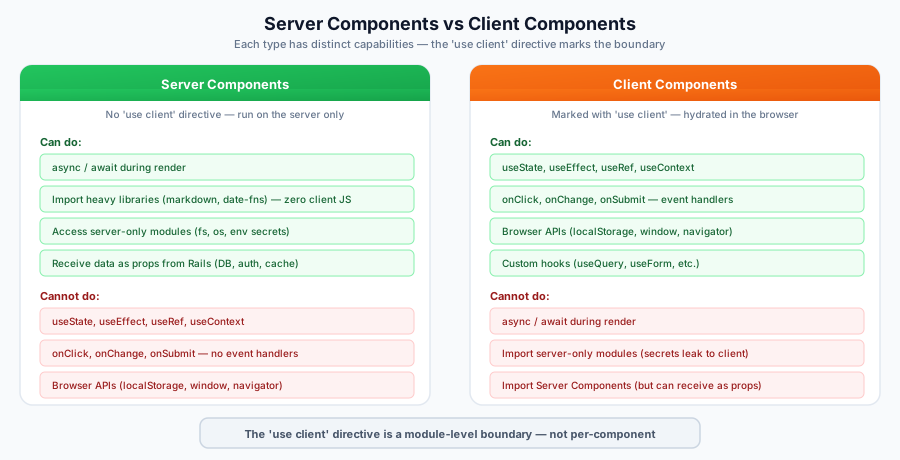
Server Components
Components that run exclusively on the server (not included in the client bundle). They can:
- Use server-only modules and heavy dependencies that never ship to the client (e.g.
fs,os, Markdown parsers) - Perform async operations during rendering
- Receive their data as props from Rails (Rails owns database access, authorization, and caching)
- Cannot contain state or browser-only APIs
For example, a Server Component renders from data that Rails passes as props:
// Server Component (no 'use client' directive) — receives data as props
function ServerComponent({ post }) {
  return (
    <div>
      <h1>{post.title}</h1>
      <p>{post.body}</p>
    </div>
  );
}
<%# Rails prepares the data and passes it as props %>
<%= stream_react_component("ServerComponent",
      props: { post: Post.find(params[:id]).as_json(only: [:id, :title, :body]) }) %>
React on Rails note: In React on Rails, Rails is the backend. The generic async-fetch-in-component pattern from other RSC frameworks (
await fetch(...)/await getDatabaseData()in the component body) bypasses Rails' authorization, caching, and session layers — and the Node renderer has no database connection and nofetchglobal by default. Prepare data in your controller and pass it as props, or stream slow data with async props. See RSC Data Fetching Patterns.
Client Components
Components marked with 'use client' directive that run on client. They can contain state, effects, and event handlers. These components get hydrated in the browser.
For example:
function ClientComponent() {
  const [count, setCount] = useState(0);
  return (
    <div>
      <p>Count: {count}</p>
      <button onClick={() => setCount(count + 1)}>Increment</button>
    </div>
  );
}
Note: Server components can import client components, but client components cannot import server components. However, server components can be passed as props to client components.
For example:
function ParentServerComponent() {
  return <ClientComponent serverComponent={<ServerComponent />} />;
}
Bundle Related
React Server Components Bundle (RSC Bundle) (usually rsc-bundle.js)
A new server-side bundle introduced by React Server Components. It contains server components and their dependencies only. It doesn't include client components. It should be the same as the server_bundle.js bundle. But it uses the react-on-rails-rsc/WebpackLoader loader to trim the client components from the bundle.
Client Bundle
The JavaScript bundle that runs in the browser, containing client components and their dependencies. This bundle is responsible for hydration and client-side interactivity.
Concepts
Flight Format (RSC Format)
The wire format used by React Server Components to stream component data from server to client. It's a compact binary format that represents the component tree and its data.
Hydration
The process where React attaches event handlers and state to server-rendered HTML in the browser. With RSC, hydration happens selectively only for Client Components.
RSC Payload (Flight Payload)
The serialized output of server components that gets streamed to the client. Contains:
- React render tree of the server component
- References to client components that need hydration
- Data for client components
Selective Hydration
A feature where client components can hydrate independently and in parallel, allowing for:
- Progressive interactivity
- Prioritized hydration of visible components
- Better performance on slower devices
Streaming
The ability to progressively send server component renders to the client before all data is ready. Benefits include:
- Faster Time to First Byte (TTFB)
- Progressive rendering of content
- Better user experience during slow data fetches
Technical
Client Component Manifest
A JSON file mapping component paths to their corresponding JavaScript chunks. Used by RSC to determine which client-side code to load for hydration.
RSC URL Path
The endpoint path where RSC requests are handled, defaulting to "rsc_payload/" in the React on Rails Pro configuration.