Rolling-Deploy Adapters
React on Rails Pro pre-seeds the Node Renderer cache so that during a rolling deploy — when the old and new versions of your app briefly run side by side — the renderer never has to cold-start a bundle in the middle of a request.
The built-in HTTP adapter does this with no extra infrastructure: the still-running deployment serves its own bundles over an authenticated endpoint, and the next deploy pulls them. This is the recommended setup for almost everyone.
TL;DR — Set three config values, use the auto-mounted controller, and in-flight requests for draining bundle versions stop paying the
410 Gone→ re-upload → retry tax. No S3, IAM, or extra gem. Jump to setup.
The problem
During a rolling deploy:
- Old Rails instances (bundle hash
abc) are still draining traffic. - New Rails instances (bundle hash
def) serve new traffic. - New renderer instances receive requests for both hashes.
Pre-seeding the current hash (def) eliminates the 410→retry only for the new bundle. Requests referencing abc still hit a cold cache on new renderers, producing 410 retries per request until the renderer has cached that bundle via upload.
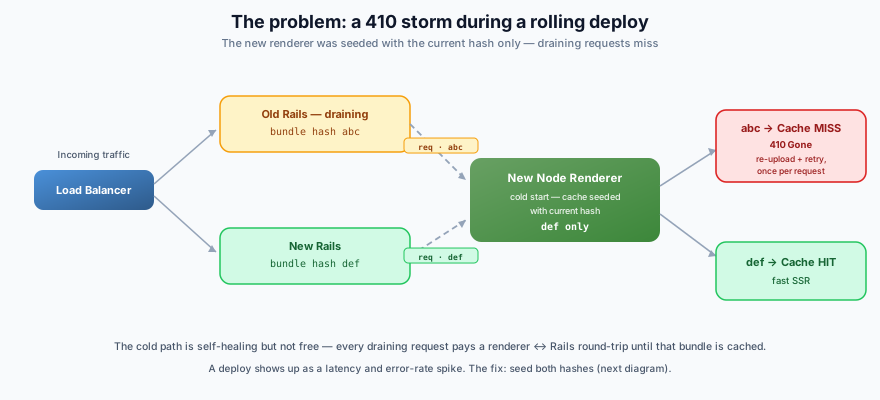
The cold path is bounded and self-healing, but it is not free. On a cache miss the renderer can't serve the request on its own: it returns 410 Gone, Rails ships the bundle over to the renderer, and only then does the request render. That extra renderer ↔ Rails round-trip — a network hop plus the bundle transfer — adds latency to every request that touches a cold bundle, and it repeats per request until that bundle is cached, so a deploy shows up as a latency and error-rate spike. The whole point of a rolling-deploy adapter is to avoid these cache misses entirely so no request ever pays that cost during a deploy.
The solution
A rolling-deploy adapter makes new renderer instances start warm for every in-flight bundle hash — not just the current one — so draining abc requests hit the cache instead of triggering a 410.
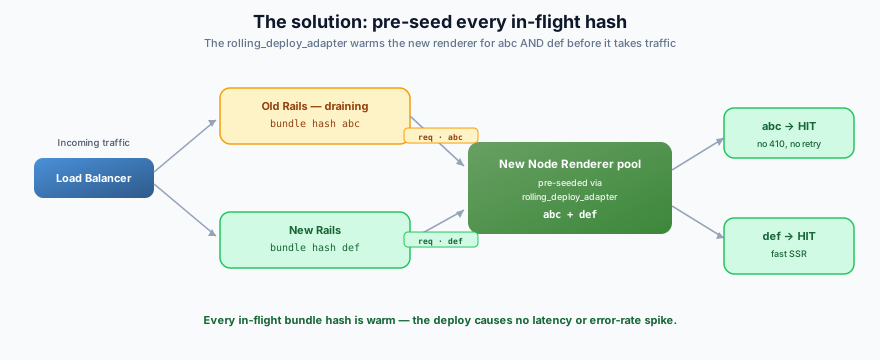
The built-in HTTP adapter is the simplest way to get there, and it's covered next. If your build can't reach the previous deployment, or you'd rather keep bundles in your own store, you can write a custom adapter instead.
Pre-seeding runs at image-build time, in the environment that builds the image. That is sufficient when the image is built and deployed in the same environment. If you promote an image between environments — build once on staging, then promote that same image to production — build-time seeding alone is not enough. See Promotion deploys need a boot seed.
Set up the HTTP adapter
Introduced as a scaffold in PR #3379 — part 1 of a multi-PR series. A hard HTTPS gate, streaming download, and additional hardening land in follow-ups; see Security below.
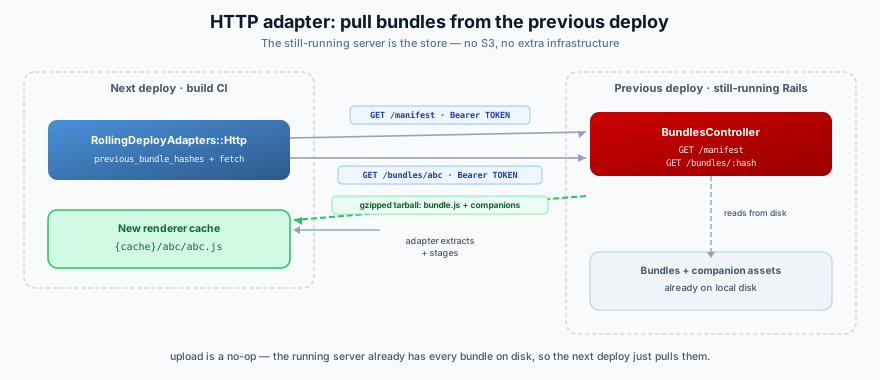
The currently-deployed Rails server already has every bundle and companion asset on disk. The HTTP adapter has the next deploy's build pull those files directly from the previous deploy over an authenticated HTTP endpoint — upload is a deliberate no-op because the running server is the store:
1. Configure the adapter
# config/initializers/react_on_rails_pro.rb
ReactOnRailsPro.configure do |config|
  config.rolling_deploy_adapter       = ReactOnRailsPro::RollingDeployAdapters::Http
  config.rolling_deploy_token         = ENV.fetch("ROLLING_DEPLOY_TOKEN")    # shared secret, ≥ 32 bytes
  config.rolling_deploy_previous_urls = ENV["ROLLING_DEPLOY_PREVIOUS_URLS"] # comma-delimited or an Array
end
rolling_deploy_token— the shared bearer token ("password"). Generate one withSecureRandom.hex(32)and set the same value on both the running server (which authenticates incoming pulls) and the build CI (which sends it). The config validator rejects tokens shorter than 32 bytes.rolling_deploy_previous_urls— one or more previous-deployment URLs reachable from the build CI or release-time seed step. It accepts an Array, a comma-delimited String, or one String. Use a bare origin such ashttps://old.example.comto inheritrolling_deploy_mount_path, or include an explicit path such ashttps://old.example.com/internal/rolling-deployto preserve that path. Order is retained and duplicates are removed. Pass more than one to seed from several environments at once (e.g. staging + production — see Multi-source seeding). Leave it unset (or empty) to disable discovery.rolling_deploy_mount_path— the Rails path where the Pro engine auto-mounts the bundle-serving endpoint when the built-in HTTP adapter is configured. Defaults to/react_on_rails_pro/rolling_deploy. Set it to a custom path when your previous deployment is reachable elsewhere, or set it tonil/blank to opt out of auto-mounting and draw the routes yourself.
Previous URLs must use HTTP or HTTPS and include a host. Credentials, query strings, and fragments are rejected. A bare origin also requires a nonblank rolling_deploy_mount_path; use an explicit path when the local engine mount is disabled.
2. Server endpoint auto-mount
When config.rolling_deploy_adapter = ReactOnRailsPro::RollingDeployAdapters::Http, React on Rails Pro automatically routes the bundle-serving controller at config.rolling_deploy_mount_path:
# config/initializers/react_on_rails_pro.rb
ReactOnRailsPro.configure do |config|
  config.rolling_deploy_adapter = ReactOnRailsPro::RollingDeployAdapters::Http
  config.rolling_deploy_token = ENV.fetch("ROLLING_DEPLOY_TOKEN")
  # No config/routes.rb entry is required for the default mount path.
end
That exposes two authenticated endpoints under the mount path (default /react_on_rails_pro/rolling_deploy):
| Endpoint | Returns |
|---|---|
GET /manifest | JSON with hashes, rsc_enabled, generated_at, protocol_version: 2, and artifact_identity: { scheme: "rorp-v2-sha256", version: 2 } for the current deploy. Older protocol-v1 manifests remain readable. |
GET /bundles/:hash | application/gzip tarball containing bundle.js plus that artifact ID's exact companion assets. |
The auto-mounted routes are prepended ahead of application routes, so terminal catch-all routes do not shadow the endpoint. They also use an internal route-helper prefix, so apps that still have an older manual mount at the default path keep booting while you remove the redundant manual route.
Manual route override
Most apps should use the auto-mount. Draw routes manually only when you need app-controlled routing behavior, such as a secondary endpoint or a wrapper around the built-in controller.
To take over routing completely, opt out of the engine route and draw your own:
# config/initializers/react_on_rails_pro.rb
ReactOnRailsPro.configure do |config|
  config.rolling_deploy_adapter = ReactOnRailsPro::RollingDeployAdapters::Http
  config.rolling_deploy_mount_path = nil
end
Set config.rolling_deploy_mount_path = "" instead when your configuration source represents opt-outs as blank strings.
# config/routes.rb
ReactOnRailsPro::RollingDeploy::BundlesController.draw_routes(
  self,
  path: "/internal/rolling-deploy"
)
To keep the auto-mount and add one or more secondary manual mounts, pass a distinct as_prefix: for each manual mount so Rails' named-route registry does not collide:
# config/routes.rb
ReactOnRailsPro::RollingDeploy::BundlesController.draw_routes(
  self,
  path: "/internal/rolling-deploy",
  as_prefix: "internal_rolling_deploy"
)
Security
- Bearer-token auth on every request (
Authorization: Bearer <token>), constant-time compare, with a uniform401for missing/malformed/wrong tokens so callers can't distinguish failure modes. - The
:hashparameter is matched against an allowlist of the current deployment's real bundle hashes — anything else returns404before touching the filesystem. - Responses carry
Cache-Control: no-store,Pragma: no-cache, andX-Content-Type-Options: nosniff. - Tarball extraction is path-traversal-proofed, accepts regular files only, and enforces a 200 MB uncompressed cap (zip-bomb guard).
- Discovery and download use monotonic overall deadlines as well as capped per-request connection/read timeouts, so a slow sequence of origins cannot reset the operation's wall-clock budget.
Use HTTPS in production. The token is a bearer credential. Over plain HTTP to a non-loopback host the adapter logs a warning that the token is being sent over an unencrypted connection; a hard HTTPS gate is planned for a follow-up release. Until then, ensure every rolling_deploy_previous_urls entry uses https:// in production environments.
Companion assets are handled automatically
Each bundle hash ships with the companion assets built alongside it — loadable-stats.json, plus react-client-manifest.json and react-server-client-manifest.json when RSC is enabled. They map chunk and component IDs to the exact asset URLs that hash's build produced, so serving a draining hash with the wrong build's manifests would break client-side hydration. The HTTP adapter packs each hash's companions into the same tarball, so this stays correct with no work on your part. (Custom adapters must return them explicitly — see Companion assets.)
Current Pro artifact IDs begin with rorp-v2- and identify the role, bundle bytes, companion destination names, and companion bytes together. Changing only a manifest or loadable-stats.json therefore produces a new ID and invalidates fragment and renderer caches consistently. With multiple previous origins, duplicate legacy/protocol-v1 hashes are omitted because their payload provenance is ambiguous. Duplicate v2 IDs are safe to try in configured order because every downloaded payload is recomputed and rejected unless it matches the requested ID.
Verified v2 previous-deploy payloads are always staged as captured files, even when pre-seeding uses MODE=symlink, because the adapter's source paths may change or disappear after their bytes are verified. Legacy/protocol-v1 payloads continue to honor symlink mode.
Promotion deploys need a release-time (boot) seed
Pre-seeding runs during assets:precompile — at image-build time, in the environment that builds the image. That is right when the image is built and deployed in the same environment, but not when you promote an image between environments.
Why promotion breaks build-time seeding
- The staging build captures only the bundles advertised by its configured previous URLs at build time.
- A multi-source configuration can capture staging and production's then-advertised bundles, but it cannot know which production bundle will be draining when a later promotion occurs.
Across two pending promotions, both candidate images can snapshot P0; after C1 promotes production from P0 to C1, promoting C2 needs the draining C1 bundle, which C2 never seeded.
The fix: seed at release time
The seed is a Rails/Rake task, so it must run in a Ruby-capable step that uses the promoted app artifact and production configuration:
bundle exec rake react_on_rails_pro:pre_seed_renderer_cache
- A combined Ruby+Node application image can run it before starting Node.
- A Node-only renderer needs a Ruby-capable init, release, or sidecar step using the promoted app artifact/config. That step and the renderer must mount the same writable shared volume at
RENDERER_SERVER_BUNDLE_CACHE_PATH, or the completed cache must be copied or synced into the renderer before it starts. Gate renderer start and readiness on that step completing. - Without a Ruby-capable step that makes the completed cache available to the renderer, this Rake seed cannot run for that renderer. Keep the multi-source build-time fallback and 410 recovery, or use a combined application shape.
When the release-time step runs before new Rails takes traffic, production's live endpoint is still served by draining old pods and advertises the exact bundle the new renderer needs.
Keep build-time seeding too; the layers are complementary:
- Build-time seed — ideally multi-source (staging + production) — is the failure floor if the boot seed cannot reach the live endpoint.
- Boot seed is the correctness path: it resolves the live draining bundle at promotion time.
Gate renderer start and readiness on the boot seed completing, not succeeding. A failed seed must degrade to the 410 fallback rather than wedge the deploy; the task already warns and continues on fetch failures.
Pre-seeding declares and prewarms the new renderer revision
The adapter and pre_seed_renderer_cache populate the renderer's disk cache with old and new bundle files plus companion manifests, so requests avoid 410 Gone, upload, and retry. The seed also emits a content-addressed declaration containing only the new revision's server artifact and optional RSC artifact. Configure the new renderer revision with the exact emitted path:
RENDERER_CURRENT_GENERATION_MANIFEST=/app/.node-renderer-bundles/.current-generations/rorp-generation-v1-<digest>.json
Each cluster worker validates that immutable declaration and its artifact roots, compiles the complete declared set, and pins it as current before listening. In supported MODE=symlink deployments, it compiles the validated immutable snapshot target and aliases the renderer-facing cache path to that same VM identity in memory, so the first request is a hit without request-time realpath work. Do not use a shared mutable current file or symlink: old and new workload revisions can race to rewrite a shared volume.
Keep the declared current contexts plus draining request generations resident during the overlap with:
maxVMPoolSize >= simultaneous bundle generations × contexts per generation
SSR-only has one context per generation. RSC has two: server plus RSC. The common old/new RSC rollout therefore needs 2 × 2 = 4 contexts per worker, which is the default. maxVMPoolSize is always a hard cap on pooled contexts; setting it to 2 during that four-context overlap causes least-recently-used eviction and can recreate the old/new rebuild loop even when every file was pre-seeded successfully.
Inactive nonmatching bundle sets drain after vmPoolRolloutDrainTimeout (60 seconds by default). The declared current set remains pinned across an arbitrarily long old-only request gap; old traffic cannot demote it. The cleanup timer runs without waiting for another request, and shared paths stay pooled while referenced. The hard cap bounds pooled contexts and prefers declared current contexts, but an in-flight old request can keep an unpooled execution context and source-map registration alive until release, so transient memory also requires concurrency headroom.
If maxVMPoolSize cannot hold the complete declared set, startup fails before the worker listens and /ready cannot pass. Additional draining contexts may be used by active requests without entering the shared pool, but the absolute pooled-context cap is never exceeded.
The fleet-wide pooled-context upper bound is:
overlapping renderer replicas × effective workers per replica × maxVMPoolSize
Include old replicas and rollout surge in the replica count. Use one effective worker for workersCount: 0. Size each renderer replica's memory request and limit from its worker/pooled-context count plus measured process, V8 heap, bundle-buffer, and safety overhead, including source maps and evicted execution contexts held by concurrent in-flight requests; multiply the per-replica request by overlapping replicas for total cluster capacity.
The built-in /ready signal means the answering worker's complete declared current set is compiled when RENDERER_CURRENT_GENERATION_MANIFEST is configured. Application-owned, authenticated Rails smoke requests remain valuable end-to-end checks, but are not needed to target every worker for VM compilation. Without a configured declaration, the backward-compatible behavior remains request-driven and /ready means only that some VM exists.
For configuration details, pressure log events, and topology-specific minimums, see Sizing and draining the VM pool and Rollout VM capacity and memory tradeoff.
Deploy the renderer before Rails
This ordering requirement applies only when the renderer is a separate workload from Rails — Option 3 in Container deployment. If Rails and the renderer share one workload — a single container or sidecar containers (Options 1–2) — they deploy on one atomic lifecycle. A Ruby-capable startup step can run the boot seed before Node serves traffic.
During a rolling deploy, the new Node Renderer must be live and cache-warm before the new Rails server starts serving traffic. If Rails goes first, the adapter's warm-cache guarantee doesn't hold for that window — you get exactly the 410 storm it's meant to prevent.
Pre-seeding warms the renderer's cache. Rails renders nothing itself; it sends SSR requests to the renderer. So a warm cache only helps if the new renderer is already up and serving when the new Rails (bundle def) starts sending it traffic:
- New Rails (
def) can only be served warm by a renderer that hasdefcached — and that's the new renderer instances. - Draining old Rails (
abc) is served warm by either fleet, because the new renderer was pre-seeded withabctoo.
If the new Rails goes live first, its def requests hit renderers that don't have def yet → 410 → re-upload → retry, per request, until the new renderer catches up. Roll the renderer out first and that never happens.
On Control Plane (and other multi-workload platforms)
Rails and the Node Renderer are separate workloads with independent deploy lifecycles, readiness checks, and warmup periods. Deploying both at once does not guarantee the renderer wins the race — the two can have different warmup/readiness settings, so Rails may begin taking traffic before the renderer's new revision is ready.
Make the ordering explicit in your pipeline rather than relying on timing:
- Deploy/promote the Node Renderer workload (new image, cache pre-seeded during its build).
- Keep it on private service networking with renderer password authentication.
- Wait until its new revision is live and healthy — readiness passing and all new renderer instances up.
- Only then deploy/promote the Rails workload; use a non-public candidate smoke gate for SSR/RSC when available.
The invariant to enforce is renderer-ready-before-Rails-live: gate the Rails workload's release on the renderer workload's release completing (sequence them as separate steps in your deploy pipeline), and/or tune the renderer's readiness probe and Rails' startup so Rails does not accept traffic until the renderer reports ready. Prefer a readiness gate over a fixed sleep — it tracks actual state. The exact wiring depends on your deploy tooling.
This ordering is also what makes the boot seed correct. The release-time step fetches the draining bundle from the target environment's live endpoint; that endpoint advertises the draining hash while old pods are still serving it. If new Rails cut over first, the endpoint would advertise the new hash and the seed would miss the bundle it needs.
Verify your setup with react_on_rails:doctor
react_on_rails:doctor probes the configured rolling_deploy_adapter and reports:
- ✅ Whether it responds to all three required methods.
- ✅ Whether
previous_bundle_hashesreturns successfully within 10 seconds, and how many hashes it returned. - ⚠️ Empty-list returns (often indicates the upload side has never run on a prior deploy).
- ℹ️ The resolved renderer cache dir and how many bundle-hash subdirectories are present.
- ℹ️ Whether
PREVIOUS_BUNDLE_HASHESenv override is set. - ✅/⚠️ The conservative old/new VM-cap formula per worker, including RSC context count.
- ℹ️ Whether both capacity and the current-generation declaration are
observedorunverified; separate workloads and ambiguous loopback sidecars stay unverified rather than producing a false warm pass.
Doctor never calls fetch or upload and does not query the live Node Renderer process — those have side effects or would require a new privileged diagnostics channel.
Need your own artifact store?
The HTTP adapter assumes the previous deployment is still running and reachable from your build. Reach for a custom adapter instead when:
- Builds run where they can't reach the running app (isolated CI, different VPC).
- The previous deployment may already be torn down by the time the next one builds.
- You want bundle artifacts to persist independently of any deployment's lifetime (for example, in S3).
The protocol is small — three class methods — and ships with copy-pasteable S3, Control Plane, and Filesystem reference implementations.
→ Custom rolling-deploy adapters
Relationship to remote_bundle_cache_adapter
These two adapters solve different problems and are complementary:
remote_bundle_cache_adapter | rolling_deploy_adapter | |
|---|---|---|
| Scope | Webpack build outputs (pre-compile caching) | Deployed bundle hashes (rolling deploy) |
| When | Build phase (assets:precompile) | Post-precompile + pre-seed phase |
| Avoids | Rebuilding webpack when source hasn't changed | 410 retries for draining-version requests |
| Keyed by | Source digest | Bundle hash |
You can configure both; they don't interact.